
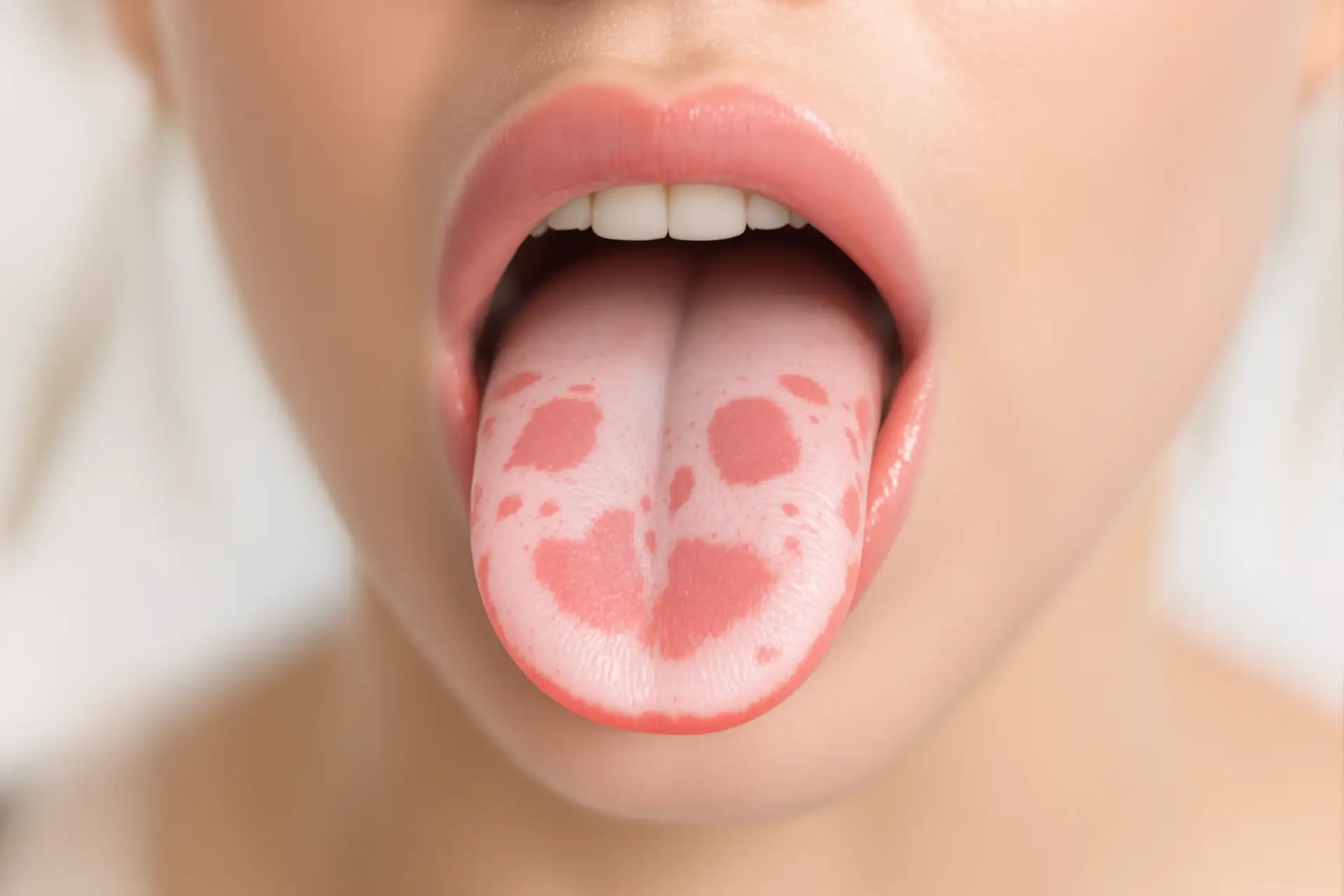



What geographic tongue is
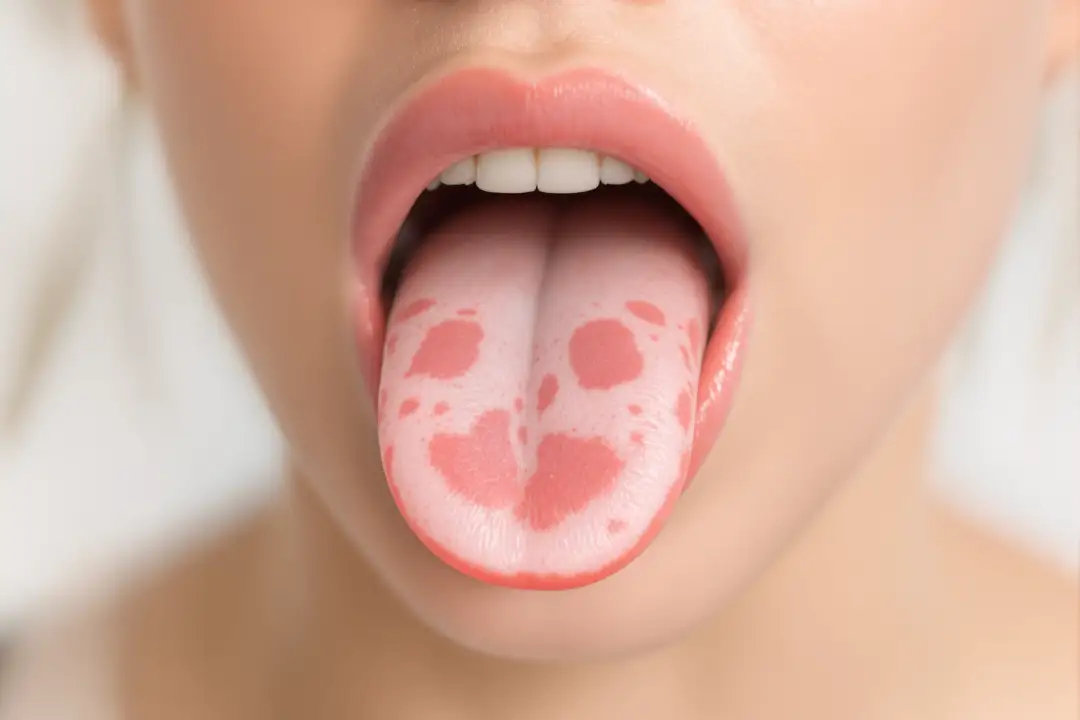
Smooth red patches on the tongue, ringed by a slightly raised, pale border, that's geographic tongue, a benign inflammatory condition. Seen up close, the patches resemble a map of islands. That's how the name came about. Its medical term is benign migratory glossitis , and 'migratory' is the word to keep in mind because the patches shift position over days or weeks. An older name, erythema migrans , has fallen out of use, largely because the same term also labels a Lyme disease rash. A patch you notice on Tuesday can vanish by Friday, while a new one forms elsewhere on the tongue.
Underneath, the process is straightforward. Across the tongue sit tiny, hair-like projections called filiform papillae , and in geographic tongue these shed prematurely in certain areas. Where they shed, the tongue turns red and smooth as the underlying tissue shows through. The pale border is inflammation, a ring of white cells gathering around the affected zone. Once the papillae regrow, the patch fades, and then the same process starts up elsewhere. Geographic tongue isn't an infection, and it isn't contagious.
How common is it? It can appear at any age, but adults get diagnosed more often, and some studies hint at a slight female bias. Around half of people with geographic tongue have no symptoms at all, they just notice the patches in the mirror. The other half feel a mild burning or sensitivity, especially after hot drinks, a spicy curry, or anything acidic like tomatoes and citrus.
What triggers it is still unknown. Family history is a clue, though, pointing to a genetic component. There's also a link to other conditions. Psoriasis is the most studied of these, and some researchers view it as an oral form of the disease. Stress and hormonal changes have been floated as contributing factors, along with some vitamin deficiencies, though the evidence for each is thin
Here is the part that matters: the condition is harmless. This isn't a sign of oral cancer, and it never turns malignant. Dentists usually recognise it on sight, and a biopsy is rarely needed. If you have patches that change position over time, that pattern itself is reassuring. That movement is the signature of this condition.
How to recognise geographic tongue
Most people don't notice geographic tongue until a dentist points it out. Pain is rare at first, so there's no pressing reason to look. You might catch it yourself, though, while brushing or flossing, a politic red zone on the tongue that stands out against the rest of the surface. If you do spot one, you'll want to know what you're looking at.
What you'll see is a red, glossy patch with a pale border. On a normal tongue, the surface is covered in tiny projections called filiform papillae, and they give it that velvety, slightly rough feel. In affected spots, those papillae have temporarily thinned out, so the tissue underneath shows through.
That's why the patch looks sleek and feels slick.
Along the edge, a white or cream border sits slightly raised, like a coastline drawn in pen.
Under natural light, check in a mirror and run a clean fingertip across the surface. Here's what to look for:
- Red, smooth patches on the top or sides of the tongue (the underside is rarely involved).
- Pale, off-white borders that sit slightly higher than the red centre.
- Shapes that shift from day to day, often moving from one side of the tongue to the other.
Doctors call it benign migratory glossitis. The changing pattern is the strongest single clue for geographic tongue. A patch present on Tuesday can fade by the weekend and resurface elsewhere the following week. A second look is deserved by Fixed lesions that never alter. Sensation differs, and many feel nothing at all. A mild burn are felt by Others often after citrus tomatoes vinegar or very spicy dishes. Flare-ups can come and go for years, with quiet stretches in between.
When it's something else
No treatment is needed for the condition itself, though a professional check removes any doubt. Oral thrush leaves a white coating you can scrape off. These patches stay clean. Lichen planus tends to show as fine white lines on the inside of the cheeks. Bleeding, a hard lump, or a sore that hasn't healed after three weeks doesn't fit the usual pattern, so see a dentist or GP rather than waiting for it to settle.
What causes geographic tongue and what triggers flare-ups
The truth: no single cause has been pinned down. Geographic tongue isn't an infection, so you can't catch it or pass it on. Nor is it connected to anything malignant. Evidence points to an inflammatory response that appears to run in families. Around a third of people with geographic tongue have a close relative with the same pattern, which suggests a genetic component.
Psoriasis has a recognised connection here too, as the two conditions share similar inflammatory pathways.
What you're actually seeing during a flare is the tongue shedding its filiform papillae, the tiny hair-like projections that give the surface its velvet texture. Where those papillae are lost, the tongue looks smooth and red, slightly thinned in places. A pale, raised border around each patch marks where the reaction is still active. That's why the pattern migrates. One area heals as another starts, and the whole map can redraw itself over a week or two.
Flare-ups often begin without an obvious prompt, but most people can trace their episodes back to one of the following:
- Spicy or acidic foods. Chilli, citrus fruit, tomatoes and vinegar-heavy dressings don't cause geographic tongue, but they can make an active patch burn for hours.
- Hot drinks, rough or salty snacks. Crisps, nuts and toast rub against a thinned surface and can provoke a fresh flare.
- Stress and exhaustion. The flare-before-a-deadline pattern comes up constantly in clinic, even though the biology behind it is poorly understood.
- Alcohol, tobacco and alcohol-based mouthwashes. All three are direct irritants.
- Hormonal changes. Some women notice patches appearing in the week before their period or early in pregnancy.
- Whitening toothpaste and strong flavourings. Sodium lauryl sulfate and intense mint get blamed in case reports, though the evidence here is thin.
Keeping a simple diary for a few weeks, noting what you ate, how stressed you felt and which toothpaste you used, usually reveals the pattern faster than any test could. That recurring trigger is the one worth acting on.
Geographic tongue and fissured tongue
Geographic tongue rarely travels alone. Around one in three people who have it also get fissured lingua, the harmless variant where the top of the tongue is etched with grooves and cracks. Spotted side by side, the two look dramatic, but neither is an infection or a sign of cancer.
The overlap is well documented. Why they cluster together is still debated, but shared genetics and a similar inflammatory response are the leading ideas. These two conditions differ in character: geographic tongue creates smooth red patches with pale, slightly raised borders that shift over days, while fissured tongue is purely structural, with deep grooves that form gradually with age.
Those grooves change how you manage flare-ups. Food debris settles into the fissures, and mild inflammation there can set off an active patch. Practical steps:
- Brush the tongue gently with a soft brush, following the line of the grooves rather than scrubbing across them.
- Rinse with plain water or an alcohol-free mouthwash after meals.
- Keep the mouth hydrated. A dry tongue makes both conditions look worse.
- Avoid very spicy, salty or acidic foods while patches are burning.
Fissured tongue needs no treatment, and geographic tongue only needs management when it stings. Make an appointment with a dentist or oral medicine specialist if a groove deepens without an obvious reason, or if a red patch stays fixed in one place for two to three weeks. Migrating patches are the condition's calling card, so tracking them over a fortnight tells you more than a single look
How geographic tongue is diagnosed
Most people find out about geographic tongue by accident, during a routine dental check-up. The dentist spots the red patches and usually names them on the spot. The look is distinctive, and hard to mistake once you've seen it.
The classic sign is a smooth, bright red area where the tiny bumps on the tongue (papillae) have worn thin, edged with a slightly raised white or cream border. Patches rarely hold still. A patch you can see today may be gone in a week, with a new one forming a centimetre away. That movement is itself a strong clue. The formal name, benignant migratory glossitis, essentially means wandering tongue inflammation.
Diagnosis is mostly a visual exercise. Your dentist may ask when you first noticed the patches and whether they sting with hot or spicy food. So this one gets diagnosed with the eyes and a good history, not with equipment. In a straightforward case, that's the whole appointment.
There's no X-ray needed, and no blood test either, and even a swab rarely enters the picture. Across the UK, most cases are diagnosed in general dental practice, and that's where it ends. Only when the picture looks unusual does a hospital specialist get involved.
When would a dentist take a closer look? These scenarios prompt extra caution:
- One patch stays fixed in the same spot for weeks, or starts to grow.
- An ulcer germinate on the tongue. It also hasn't healed within three weeks.
- The patch looks unusual enough that oral lichen planus or oral thrush can't be ruled out.
Sometimes a biopsy is taken in those situations, though it's uncommon. Any mouth sore hanging around past three weeks deserves a proper look, regardless.
Blood tests aren't routine. But if your tongue is sore, you feel persistently tired, or you look pale, a GP might check iron, folate, and vitamin B12. Deficiencies can change how the tongue looks, even if they aren't the cause of the patches in most people.
Practical trick, take a photo of your tongue at home, then another in three or four weeks. If those patches have shifted, that's a strong sign of geographic tongue. For most people, that alone is enough to end the worry