
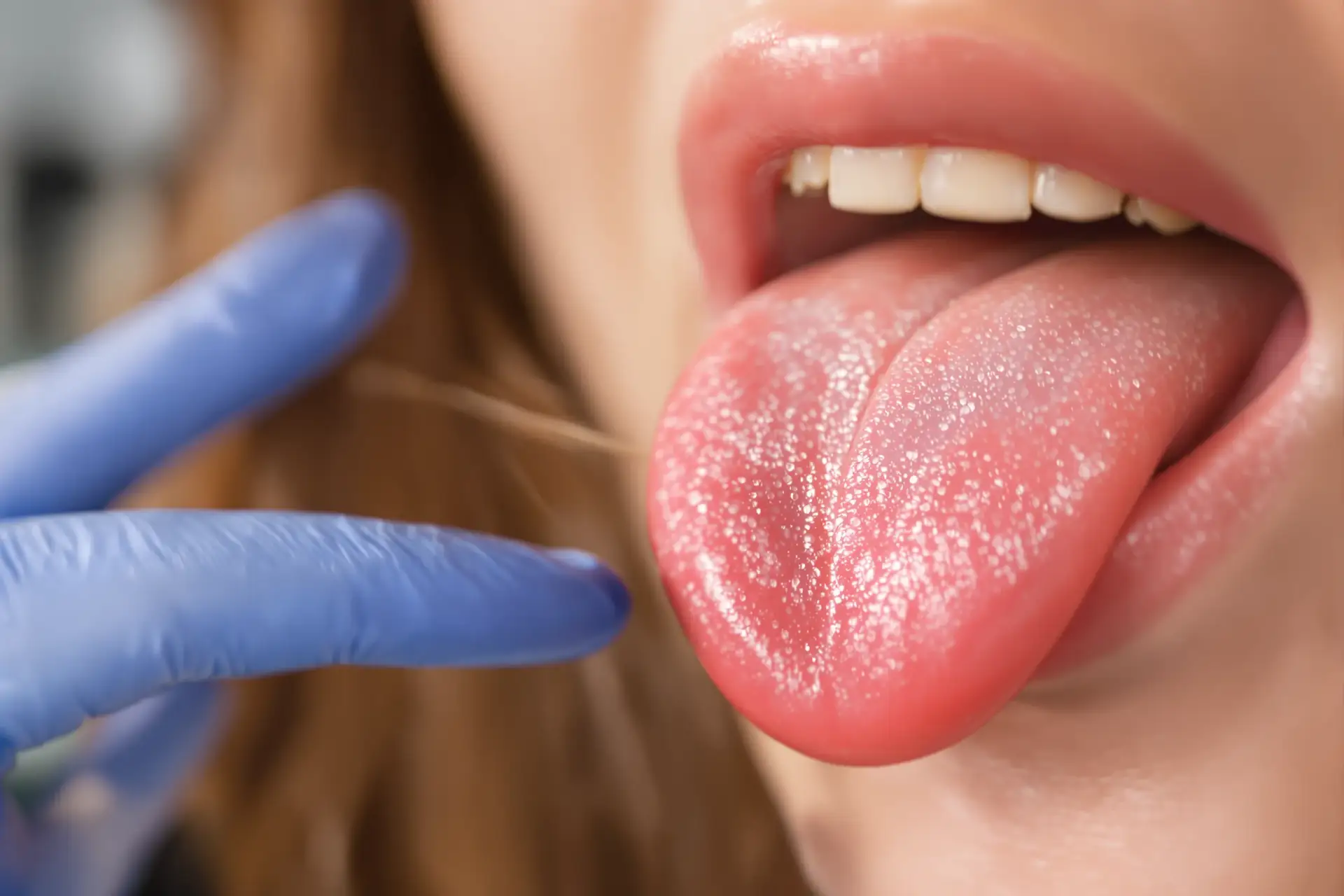



What is geographic tongue?
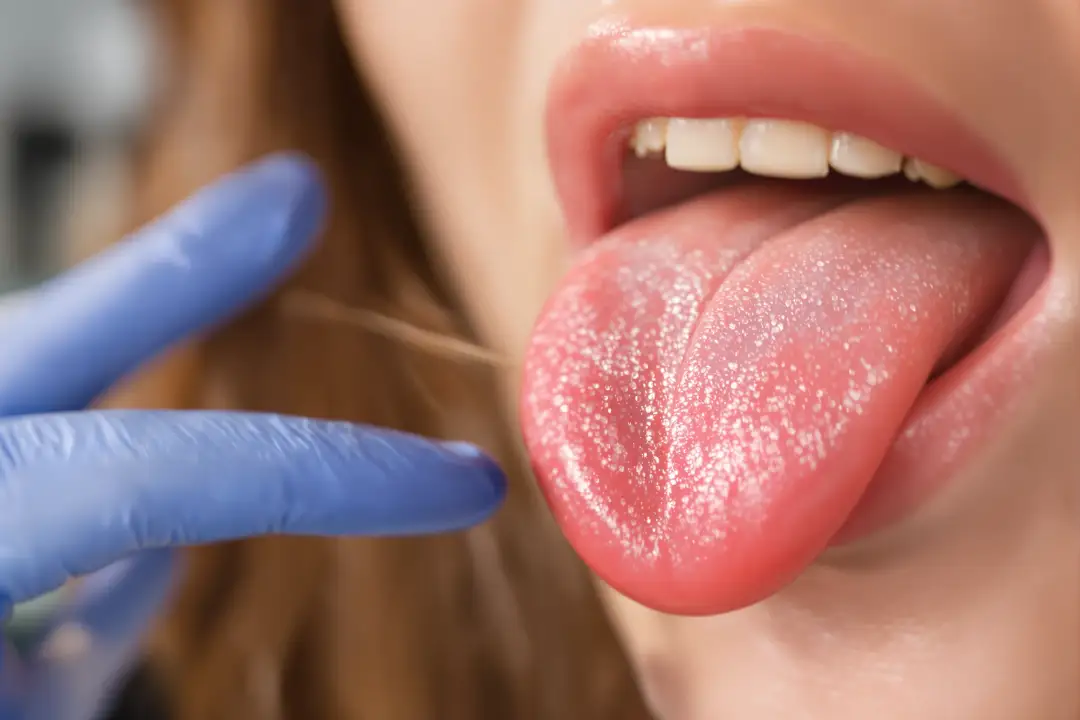
Geographic tongue, a harmless inflammatory condition, shows up as smooth red patches on the top and sides of the tongue. In those red patches, the tiny papillae (the small bumps that give the tongue its velvet-like texture) have temporarily worn away. Around each patch runs a pale, slightly raised border. That mix of red and pale gives the tongue a map-like look, and that's exactly where the condition gets its name. Its shape shifts as patches heal and reform, so the map redraws itself every few days or weeks.
Clinically, it's called benign migratory glossitis. Benign, because the condition isn't dangerous. Migratory, because the lesions wander from one part of the tongue to another. It's not rare.
Any age can be affected, though adults are more likely to develop it. Some studies report a slight female predominance, and the evidence is inconsistent, so I wouldn't lean on it. People with a fissured tongue, psoriasis, or a close relative with the same tongue pattern are more likely to develop geographic tongue.
For many people, geographic tongue causes no symptoms at all. Often, it gets picked up by chance during a routine check-up or a scale and polish. Symptoms, when they do appear, are usually mild: a burning sensation, or sensitivity to hot drinks, spicy food, citrus and tomatoes. Flare-ups can last a few days, settle down. It also then return weeks or months later. Most people need no treatment at all. When discomfort is the issue, the fix usually comes down to avoiding triggers, not taking medicine.
Two facts matter here. Geographic tongue isn't contagious, and it isn't cancer. Your risk of oral cancer doesn't rise either. The main reason to see a dentist is diagnosis, since other conditions such as oral lichen planus and thrush can look very similar. Beyond that, book an appointment if:
- a patch stays fixed in one spot for more than three weeks
How to recognise geographic tongue
People usually notice it by accident. It shows up in the mirror one morning, often after a dentist or hygienist pointed it out during a routine check. That figure is hard to miss: smooth red patches with pale, slightly raised borders scattered over the upper surface of the tongue. Those are zones where the tiny papillae have temporarily thinned out or vanished, leaving the surface looking raw. These aren't ulcers, and they don't bleed or crust. For most people they cause no pain at all, which is why the condition usually surfaces during a dental check-up rather than at home. The defining feature is movement. The red areas shift, merge and fade over a few days, then reappear somewhere else. That is where the name comes from, because the pattern changes like a coastline seen from above. Clinicians call it benign migratory glossitis. The word "benign" matters here. This is not cancer, and it's not an infection. You can't pass it on through kissing or sharing cutlery. Some people also notice a mild metallic taste or sensitivity to strongly flavoured toothpaste during a flare.
The classic signs
- Bland red patches with a white or pale yellow border, usually a few millimetres to two or three centimetres across.
- Position: top and sides of the tongue. The underside is rarely involved.
- A shifting pattern that looks different after a few days. The same patch rarely stays in one place for long.
- Mild burning in roughly half of cases, most noticeable with hot drinks, spicy food or acidic fruit.
A quick way to separate geographic tongue from conditions that look similar is to watch what happens over time. With oral thrush, the white coating scrapes off and leaves sore skin underneath. Lichen planus, in contrast, produces fixed lace-like white lines that stay in place. A canker sore is one painful ulcer confined to a single spot. Patches of geographic tongue drift, and the change is often visible within 48 hours. Any red patch that remains in exactly the same place for weeks is not typical behavior, and it deserves a professional look. Your dentist will have seen it many times before, and diagnosis is purely visual. No biopsy. Blood tests aren't needed. Just a careful look under good light. If you're ever unsure, photograph your tongue every couple of days, same spot, same light. The shifting pattern on your phone is usually the clearest evidence. Once you recognise it, the practical question becomes what calms it down and what sets it off.
What causes geographic tongue
There is no single cause. Most cases of geographic tongue are what clinicians call idiopathic, a term that sounds technical but simply means the inflammation appears without a clear reason. Those shifting patches are a benign inflammatory reaction, not an infection, and not a sign of cancer.
Genetics is the strongest lead. The pattern runs in families, overlapping heavily with two other tongue conditions, fissured tongue and psoriasis. Roughly one in five people with geographic tongue can name a parent or sibling with the same pattern, and family history is one of the few consistent findings in the research. In a condition with no lab test, that counts for a lot.
That psoriasis connection deserves its own paragraph. Both stem from the same immune response, where specialised cells overreact and the tongue sheds its small papillae. This overlap is too consistent to ignore.
Fissured tongue, the deep grooves running along the middle of the surface, turns up alongside geographic tongue in about a third of cases. Such a degree of overlap is hard to put down to chance. It points toward shared genetic wiring that affects how quickly the tongue's papillae renew themselves.
Beyond genes, the evidence thins out. Zinc and B-vitamin deficiencies show up in individual case reports but not in larger population studies. Research here is thin, so these remain possibilities rather than confirmed links. Hormonal shifts get raised too, because flares sometimes begin in pregnancy or soon after someone starts a combined contraceptive pill. Stress can spark flares, but it doesn't create the tendency in the first place.
What does not cause it
Plenty of popular suspects have no bearing on it:
- poor brushing or a 'dirty' mouth
- kissing, sharing cutlery or a drinking glass
- any particular toothpaste
- alcohol or smoking
It does not spread from person to person, full stop. So the causes sit mostly in the immune system and the family tree, not in anything you ate or failed to clean.
Common flare-up triggers
Nobody pinpoints flare-up triggers with total certainty because geographic tongue behaves differently from person to person. What fires up one tongue leaves another completely quiet. Still, a few patterns come up again and again in clinics.
Stress and fatigue
A heavy work week, poor sleep or a lingering cold can all precede a flare. Patients often report that patches appear or spread within a few days of these. Cortisol spikes get the blame, though the link is more anecdotal than proven.
Food and drink
Spicy dishes lead the list. Chilli, curry, hot sauces and raw garlic can make patches sting or burn within minutes. The same goes for acidic food. Tomatoes, citrus fruit and vinegar-based dressings top the list of offenders. Then there's temperature itself. A really hot cup of tea or coffee can nettle the surface of the tongue, and in some individuals the reaction doesn't show up until the next forenoon rather than right away.
Oral care products
Toothpaste takes plenty of blame. Strong mint flavours, sodium lauryl sulphate (SLS) and whitening agents come up again and again in patient accounts. Switching to a mild, SLS-free toothpaste helps some people settle their geographic tongue within a couple of weeks, though the evidence is mostly anecdotal.
Alcohol, smoking and mouthwash
Alcohol and tobacco both dry out the mouth, and the resulting dryness tends to make the pattern worse. Mouthwash with alcohol is worth setting aside as well, especially when patches are already visible.
Hormones
Women sometimes notice a flare mid-cycle or during pregnancy. Hormone shifts are accepted as a factor because the pattern gets reported often enough, even if the exact mechanism remains unclear.
Finding your own triggers
Start a simple diary for two to three weeks. Record what you ate, what you drank, how you slept and whether the patches changed. Most people identify one or two reliable triggers this way, then avoid those instead of cutting everything out at once. If a specific food keeps making things worse, drop it for ten days and bring it back slowly. That usually distinguishes a real trigger from pure coincidence. Stress comes up as the main trigger for about a third of patients, so sleep and a proper wind-down routine can end up doing more than any diet change. If the diary turns up nothing, your dentist can usually help connect the dots.
Is geographic tongue linked to fissured tongue?
Yes, this association is one of the more consistent findings in oral medicine. About one person in three with geographic tongue also has fissured tongue, a condition where the surface develops visible grooves.
Fissured tongue is easy to spot. A deep central groove down the middle of the surface is its best-known feature, sometimes joined by smaller furrows branching toward the edges. They are painless. Most people never realize they're there.
The link runs both ways. Having fissured tongue raises the odds of also having it, and the reverse holds too. No single cause has been pinned down, but the two seem to share a common background, possibly genetic, possibly tied to stress or an immune response.
From a clinical standpoint, what matters is that neither poses a risk. Neither is contagious or precancerous, and treatment is rarely needed. Food debris can get caught in the grooves, so if the tongue ever feels a little raw, a few extra seconds of gentle brushing or a rinse usually settles it.
Practically speaking, that link is useful. Deep fissures found at a routine check typically prompt your dentist to look for geographic tongue's red patches, just as red patches would prompt a fissure check. Finding either one is a reason to watch for flare-ups, not a cause for concern.