



What Is the Norwood Scale?
Dermatologists and hair restoration surgeons have used the Norwood scale since the 1970s to classify hair loss. The pattern was first sketched by Dr. James Hamilton in 1951, but Dr. O'Tar Norwood refined it into the seven-stage model used today. The scale maps the progression of male pattern baldness (androgenetic alopecia) from a full head of hair (stage 1) to a near-bald horseshoe rim (stage 7).
Each stage captures a specific recession pattern, and stage 2 shows a slight temple recession. Stage 3 marks the first visible bald spot on the crown or a deeper temple line, often the point when men start paying attention. By stage 4, the vertex bald patch meets the front recession, separated only by a thin band of hair. In stages 5, 6, and 7, that band disappears and the bald area expands to the sides.
Why does this scale matter? It gives both doctor and patient a common language. Instead of 'I'm losing hair on top,' a patient can say 'I'm a Norwood 3A.' That precision guides treatment decisions. A stage 2 patient might respond well to topical minoxidil, while a stage 5 patient is likely looking at a transplant.
Patients often fixate on their Norwood stage number, treating it like a ranking they want to stop climbing. The Norwood scale doesn't predict how fast a patient will progress-it only documents where they are today. Some men stall at stage 3 for decades, and others progress through stages 2-5 within three years.
The Norwood scale captures that range without judgment-it's just a map, not a sentence
The system isn't perfect. It can't account for diffuse thinning that starts at the crown without temple recession (sometimes called a Norwood 4A these days, though the original scale didn't include that).
Norwood Scale Stages 1–7: A Complete Breakdown
The Norwood scale stages 1-7 are defined by how much hair has been lost at the temples and crown. Not everyone progresses through all stages-some stop early, others keep going. Here is what each stage actually looks like.
Stage 1 - Minimal recession
In stage 1, there is no real hair loss, and the hairline sits about an inch above the brow. One might see a tiny bit of temple thinning, but nothing that would be called a problem.
Stage 2 - Slight temple recession
The hairline pulls back about 1-1.5 inches at the temples. This is the classic 'mature hairline' that most men develop in their late 20s. There is still plenty of coverage.
Stage 3 - First visible bald spot
At this stage, two patterns may emerge: the hairline recedes further (stage 3A) or a bald patch appears on the crown (stage 3V). Often, a 2-3 inch triangular area of missing hair appears at each temple. Men typically lead off to notice the loss and start researching treatment options at this stage.
Stage 4 - Deep hairline + crown thinning
Each temple has receded approximately 3 to 4 inches from the brow. A bald spot forms on the crown, often 2-3 inches across. These two areas are separated by a strip of hair running across the top. That strip of hair is thinner than at earlier stages.
Stage 5 - The bridge narrows
Balding areas on the hairline and crown may merge, or remain separated by just a thin band of hair. A crown patch can be 4-5 inches wide. Stage 5 on the Norwood scale is defined when the bridge of hair is narrower than the crown area.
Stage 6 - Near-complete top loss
Then, the bridge of hair disappears entirely. Hair remains only on the sides and back, forming the classic 'horseshoe' pattern. From forehead to crown, the top of the scalp is bald. Sides remain relatively full.
Stage 7 - Bald top, thin sides
Thinning also occurs on the sides and back, and the horseshoe-shaped area continues to shrink. What remains is only a narrow ring of sparse hair. Development from stage 1 to this point typically takes between 15 and 30 years.
Norwood's scale defines each stage with a distinct pattern and extent of hair loss. Plateauing at stage 3 or 4 is common among men. Tracking current stage and progression speed is facilitated by the scale.
How to Determine Your Norwood Stage
Determining one's Norwood stage requires no medical degree-just a mirror, good lighting, and a close look at the scalp. Simple in concept, the scale includes seven stages from no loss (stage 1) to a full horseshoe (stage 7). Men who first notice thinning usually fall between stages 2 and 5.
Step-by-step self-assessment
- Grab a handheld mirror and stand under bright light, and natural daylight from a window works best. Difficult-to-see areas can be identified with the help of a friend or partner.
- Equate your hairline to the standard Norwood images, and recession at the temples is a key sign. Early thinning often presents as a slight M shape with a full center. That's stage 2. If the M has deepened so your hairline sits more than an inch above your eyebrows, you're likely at stage 3. The original Norwood classification specifically marks stage 3 as the point where recession becomes clinically significant.
- Check your crown. Part your hair and look at the back of your scalp from above. A small round or oval patch of thinning there, combined with temple recession, often means stage 3 vertex or stage 4. If only the crown is thinning and the front hairline looks unchanged, you might be looking at a stage 5 or worse.
- Take a photo from overhead. Hold your phone directly above your head, snap a picture, then compare it to a Norwood chart online. This removes the guesswork of trying to see the back of your own head
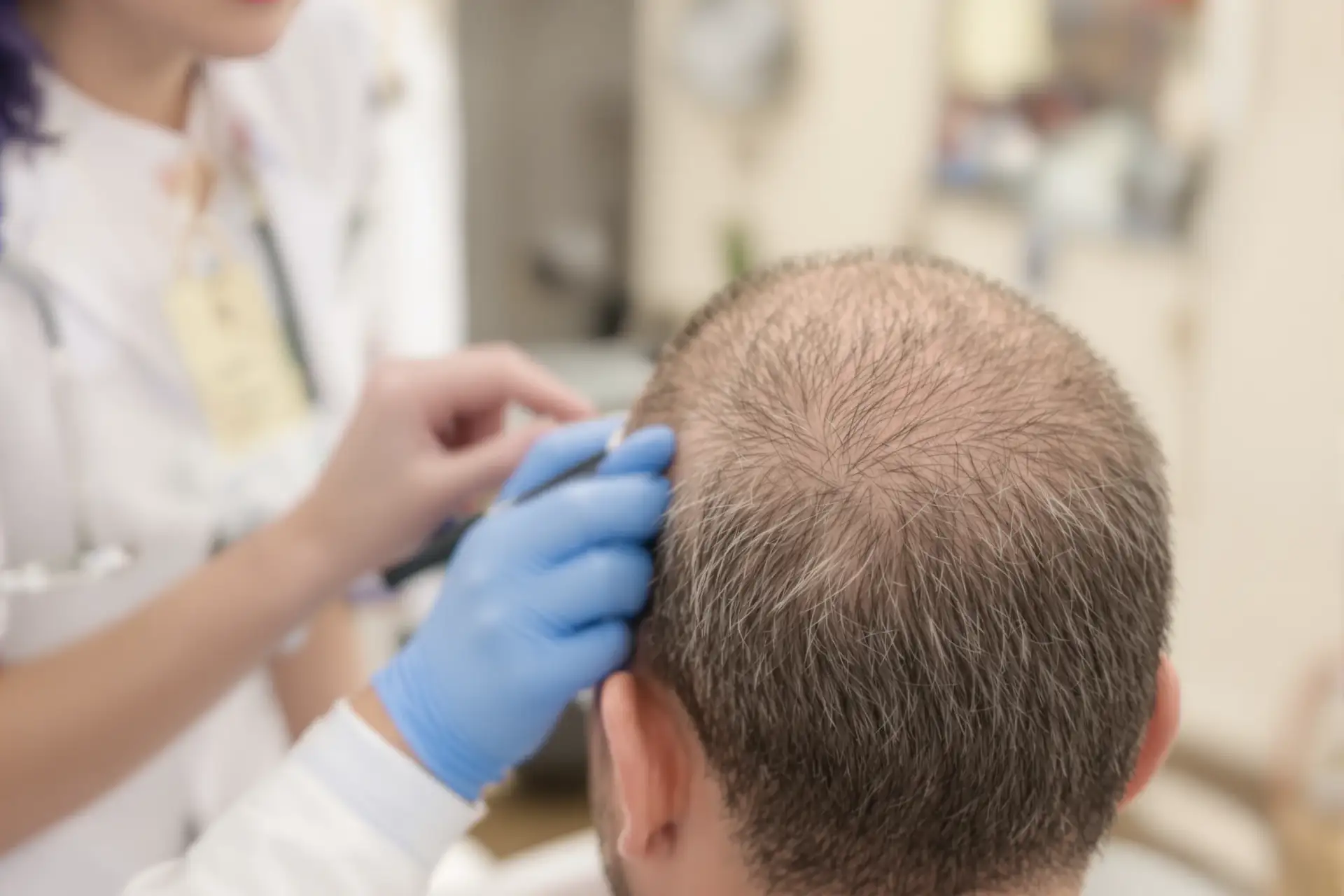
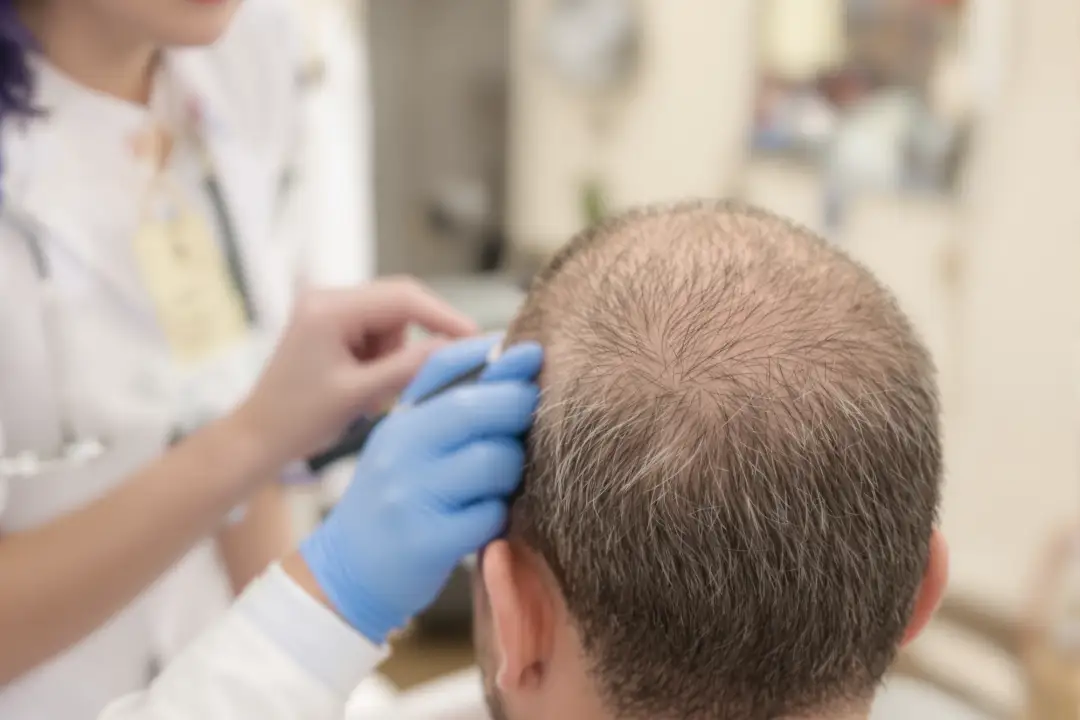
- If you're still unsure, see a dermatologist. A quick trichoscopic exam takes about 30 seconds and can confirm your Norwood stage with far more precision than any mirror. The doctor will also check for miniaturization of hairs along the frontal hairline-a key sign of active androgenic alopecia.
One thing I often tell patients: the Norwood scale isn't a perfect diagnostic tool. Some men have a deep front recession with a full crown, while others show a tiny bald spot but a solid hairline.
Common Questions About Hair Loss Stages
How does the Norwood scale classify hair loss stages?
It map male pattern baldness into seven main stages, and stage 1 is no hair loss. Stage 7 is knockout baldness, with only a narrow horseshoe of hair around the sides and back. Each stage captures a specific pattern of recession and thinning.
How long does it take to move between stages?
There's no fixed timeline. Others accelerate through Stage 3 within 18 months. Genetics and hormones drive the pace, not a calendar
At what stage should I consider treatment?
Most dermatologists say intervention works best at Stage 2 or early Stage 3. That's when the crown first hints at thinning or the temples recede noticeably. Finasteride and minoxidil are most effective at preserving what you have, not regrowing full coverage. Waiting until Stage 5 cuts your options down.
Can women use the Norwood scale?
No. Women's hair loss usually follows a different pattern - a diffuse thinning over the entire crown, not a defined receding hairline or bald spot. The Ludwig scale is the standard classification for women. If you're a woman reading this, the Norwood scale will not help predict your progression.
Is hair loss at Stage 7 reversible?
Stage 7 means near-total baldness on top. Medication rarely restores much coverage by that stage. Hair transplants are possible but limited by donor supply, the patient needs enough healthy follicles at the back and sides.
Treatment Considerations by Norwood Stage
Treatment varies considerably across the Norwood scale. What works for a Norwood II might not work for a Norwood V, and that is worth understanding before committing to treatment. Early stages (Norwood I to III) generally respond best to medical therapy. Finasteride and minoxidil are the mainstays here. Patients with Norwood III have kept their hair steady for years with these two medications. The key is consistency, missing a week leads to noticeable effects. At these stages, the patient is mostly maintaining coverage and possibly thickening the crown. Mid-stage (Norwood III vertex to IV) gets trickier. The patient has lost enough that medications alone might not be sufficient. Many men at this stage consider hair transplants. The Norwood scale helps surgeons plan graft placement, they avoid transplanting into areas that are likely to thin later. Follicular unit extraction (FUE) is common for this group. Recovery takes about 7-10 days before the patient returns to public settings. Advanced stages (Norwood V to VII) have fewer options. Medical therapy can still save remaining hair, but a full head of regrowth is unlikely. Transplants are possible but require a significant donor supply, and not every patient has that. Some patients opt for scalp micropigmentation or simply shave their head clean. A Norwood VII rarely ends up looking like a Norwood II again, no matter the cost.