:no_upscale()/media/ic/images/2026/02/29fedc4f885d4517814e7ad43cc5df63.webp)
:no_upscale()/media/ic/images/2026/09/temple-hair-transplant-fue-turkey-2026-in-article.webp)
:no_upscale()/media/ic/images/2026/04/Tugba-Hoca.webp)


What Is a Temple Hair Transplant?
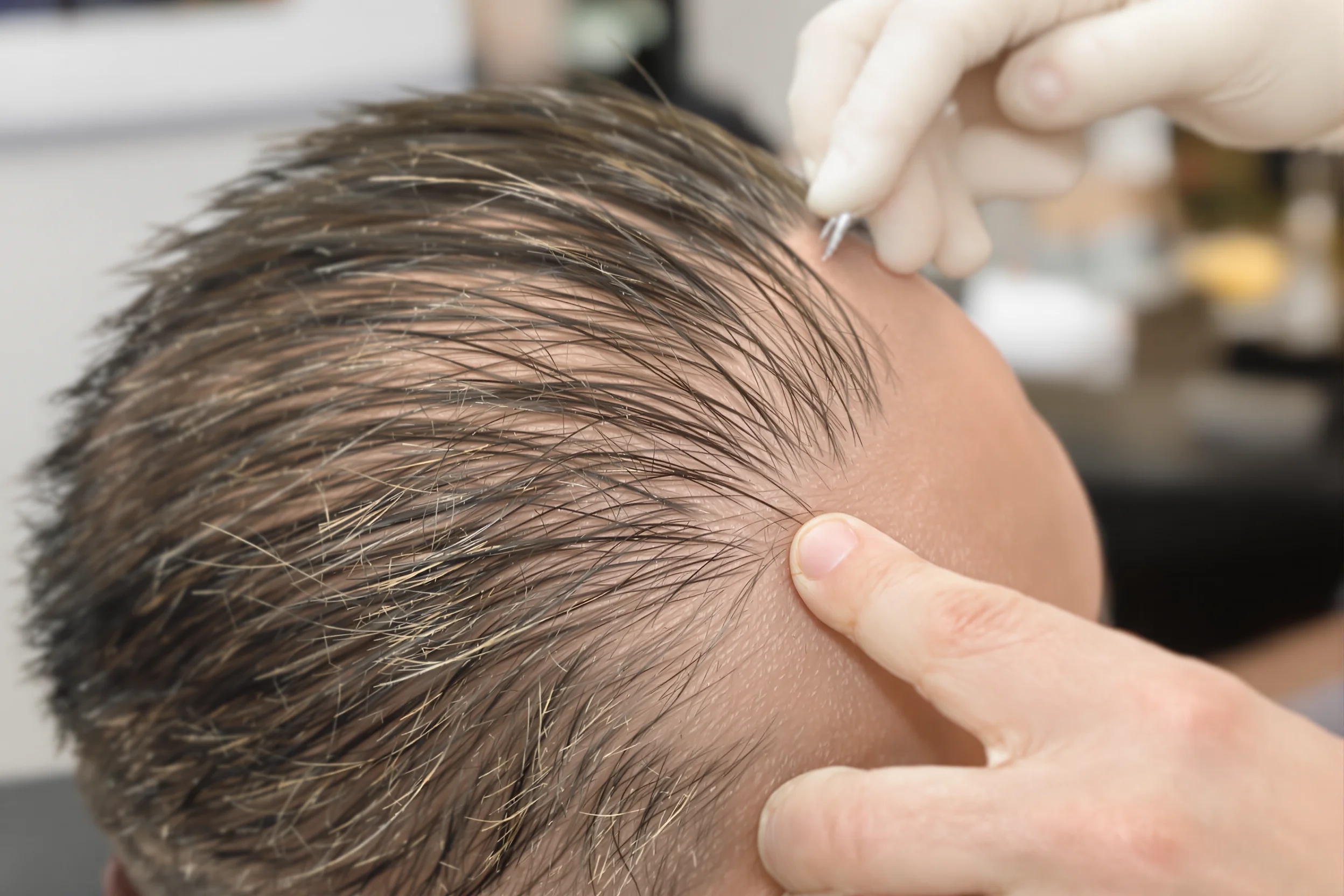
Temple hair transplant surgery does what the name suggests-restores hair to the sides of your forehead where it used to be. Often called temporal recessions, those hollows creep backward in many men as early as their twenties. It's genetic, not a health crisis, but it changes the shape of the face. Full and straight, your hairline becomes M-shaped, and the temples can feel bare.
During the procedure, FUE moves individual grafts from the back of the scalp, the permanent donor zone, to the temple area. Standard FUE and temple FUE are the same operation, and but temple FUE demands more precision. Because temple hair needs a shallower angle than the top of the head, the hairline must look natural, not pluggy. Surgeons harvest 500 to 1,500 grafts per side, depending on how far the hairline has receded.
Local anaesthetic is used, and you're awake but feel nothing. Four to six hours per session. Afterward, tiny red dots appear where the grafts were placed. They scab over and fall off within a week. Transplanted hairs shed at around three weeks, which is normal, and regrowth starts at three to five months. You're looking at about a year for full results.
It's all about the angle and direction of each graft, plus the density gradient. A solid wall of hair, and that's not the goal. The best results mimic that natural transition from forehead to temple. That's what separates a temple hair transplant from a generic hairline fill
Why Do Temples Recede and How Do They Frame the Face?
Temple recession isn't random, and it follows a predictable pattern-driven by genetics and dihydrotestosterone (DHT). The hair along the frontal hairline and temples is unusually sensitive to DHT. Those follicles shrink with each cycle, until they eventually stop producing visible hair. For most blokes, this starts in their late twenties or early thirties-though some notice it as early as eighteen.
Why do these two small patches matter so much, and because they literally shape the face. A soft diagonal line from the brow is created by A full temple region to the sideburn. That's what gives the face a balanced, oval appearance. When the temples hollow out, the forehead looks wider, the cheekbones more prominent-the whole face can seem older or more angular. Think of it like a picture frame: if the frame thins on one side, the image inside changes. A temple hair transplant isn't cosmetic fluff. It's about restoring that natural border.
Guys have told me they stopped going for haircuts-barbers kept mentioning their 'widow's peak' getting worse. The psychological toll is real. That's where a modern FUE approach to temple hair transplant comes in. It rebuilds the temporal peak, one graft at a time, using hair from the back of the scalp-genetically immune to DHT. The result isn't just extra hair. It's a softer, younger-looking face.
Who Is a Good Candidate for Temple Restoration?
Not every receding hairline makes a suitable candidate for temple restoration. The procedure works best when you have a clear pattern of temple recession that's been stable for at least a year or two
Candidates who do well usually fall into Norwood classes 2 to 3 on the male pattern baldness scale. That's the stage where the temples have pulled back noticeably but the rest of the scalp still has decent coverage. If your crown is thinning heavily at the same time, you might need a different approach-restoring temples alone won't balance the overall look.
There's no negotiating on donor hair. The grafts come from the dorsum and sides of the scalp, and the surgeon needs enough healthy follicles to transfer 1,000 - 2,000 grafts per side. If your donor area is sparse or has been harvested before, temple work may be limited. Skin laxity also matters-tighter scalp can limit the number of grafts you can take in one session.
Age is another factor to consider. Most surgeons won't touch patients under 25, hair loss patterns need time to show their hand. Stability beats the number every time
Realistic expectations? Non-negotiable. Temple restoration can lower the hairline, soften the face, but it won't stop future loss elsewhere. You'll need to account for follow-up sessions down the road.
The ideal candidate has stable temple recession, good donor supply, and a clear-eyed view of what the procedure can and can't do.
The FUE Procedure at la clinica: What to Expect
If you're coming to la clinica for a temple hair transplant , the day itself follows a predictable rhythm. Clinics here run lean, six to eight patients a day, each with their own team. First up: you sit with your surgeon, not a consultant.
The real work starts with a face-to-face drawing. The surgeon marks your temporal points and the new hairline with a washable pen. They hand you a mirror and ask you to nod along. That's normal. The angle of the hair at the temples makes a massive difference. Get it wrong and it looks painted on
Once the designing is finalized, they shave the donor strip at the back of the head. Some clinics shave the whole crown, and others only shave a narrow band. la clinica keeps it discreet-a palm-sized rectangle above the ears. First, they inject local anaesthetic along the donor strip. Fifteen to twenty tiny pricks, then nothing. Throughout the extraction, you're awake, face down on a padded bed.
Extraction runs about three to five hours for a typical temple case-say 600 to 1,200 grafts. Using a 0.7-0.9 mm punch, the surgeon or senior technician isolates each follicular unit. They're pulled out one by one, sorted under a microscope, and stored in a chilled solution. Every hundred grafts, the team counts them aloud, and numbers are called out: 'four hundred… five-fifty… eight hundred.' No mystery there.
After a break-lunch, tea, a walk to the loo-you flip over. Recipient area gets another shot of anaesthetic, and surgeon makes tiny incisions along the drawn angles. For temples, these incisions are shallow and sharply angled forward-about 30 to 40 degrees from the skin. That specific direction is what makes a temple transplant work. Natural temple hair sweeps backward, not straight down like on the crown.
Implantation is the slow part, and using forceps, technicians drop each graft into its incision. Working in pairs, they keep the grafts' time outside the body under four hours. From first incision to final graft, the whole thing takes another two to three hours for temples. Total time in the chair: six to eight hours, depending on the graft count.
What about pain, and honestly, the anaesthetic stings for about thirty seconds per injection. After that, you feel pressure but nothing sharp. Most patients scroll through their phones or nap. By the end, the temples are a little swollen and scattered with tiny scabs. Clinic washes your scalp, wraps it in gauze, and hands you aftercare instructions plus a surgical cap.
No overnight stay. By early evening you're back at the hotel, typically with a protective headband on. Hardest part? The first night, you sleep slightly upright to avoid rubbing the area. But by morning, the real waiting game begins.
Temple Hair Transplant Cost: Affordability in Turkey
Back in the UK, temple restoration doesn't come cheap. That's for the procedure alone, travel, accommodation, and aftercare are extras
What drives the price in Turkey?
Key points:
- Graft count. Each side of the temple typically needs 500-1,200 grafts
- Clinic volume. Turkish clinics handle more patients, which keeps overhead per patient lower. They're efficient. Quality isn't compromised, many surgeons here trained in Europe and the US.
- Package deals. Most reputable clinics bundle everything: the surgery, 3-4 nights in a decent hotel, private transfers, and sometimes even post-op medication. No hidden bills.
The math is hard to argue with
One catch: cheap doesn't mean bargain-bin. A proper clinic will insist on a consultation, use microscopes for graft dissection, and assign a dedicated nurse for follow-up