/media/ic/images/2026/02/29fedc4f885d4517814e7ad43cc5df63.webp)
/media/ic/images/2026/02/saphhire-fue-breadcrumb.webp)
Sapphire FUE Hair Transplant
Sapphire FUE Technique in Istanbul Care



| Aspect | Classic FUE (Steel Blades) | Sapphire FUE | DHI (Choi Pen) |
|---|---|---|---|
| Recipient Incision Tool | Steel slits (U-shaped) | Sapphire blades (V-shaped) | No pre-channels (direct pen) |
| Incision Precision/Healing | Standard, more crusting | Superior, faster, minimal crusting | Minimal trauma, quickest |
| Tissue Trauma | Moderate | Lower (smoother cuts) | Lowest |
| Density Potential | Up to 40-45 grafts/cm | Up to 50 grafts/cm | Up to 60 grafts/cm |
| Recovery Time | 7-10 days visible scabs | 5-7 days, reduced edema | 5-7 days |
| Best For | Cost-effective large coverage | Balanced density and healing | Precision density, no-shave |
| Scarring/Comfort | Minimal dots | Even less noticeable | Least disruptive |
Sapphire FUE delivers technical refinements that enhance standard FUE results, offering durable, natural hair restoration with evidence-based improvements in patient comfort and aesthetics. In experienced hands, it provides excellent value for those prioritizing smooth recovery.
Sapphire FUE Hair Transplant: A Surgeon’s Honest 2026 Guide
Sapphire FUE is one of those hair transplant terms that sounds more complicated than it actually is. In simple terms, it is a refined version of the classic FUE method. The grafts are extracted in the same way as standard FUE, but the recipient channels are opened with sapphire crystal blades instead of steel blades.
That small change matters. The blade used during channel opening affects how closely grafts can be placed, how much trauma the skin receives, how quickly the recipient area settles, and how natural the final hairline looks once the hair grows in.
At Istanbul Care, we usually recommend Sapphire FUE for patients who want a dense, natural-looking frontal hairline and need a medium-to-large session. It is not a magic technique, and it is not right for everyone. But in the right hands, and for the right patient, it can make a visible difference.
What Sapphire FUE Actually Is
The first thing to understand is this: Sapphire FUE is not a completely separate hair transplant method. It is still FUE. The “sapphire” part refers only to the blade used while opening the channels in the recipient area.
Every FUE-based hair transplant has three main steps. First, follicular units are extracted from the donor area. Then, small channels are opened in the area where the hair will be placed. Finally, the grafts are implanted into those channels.
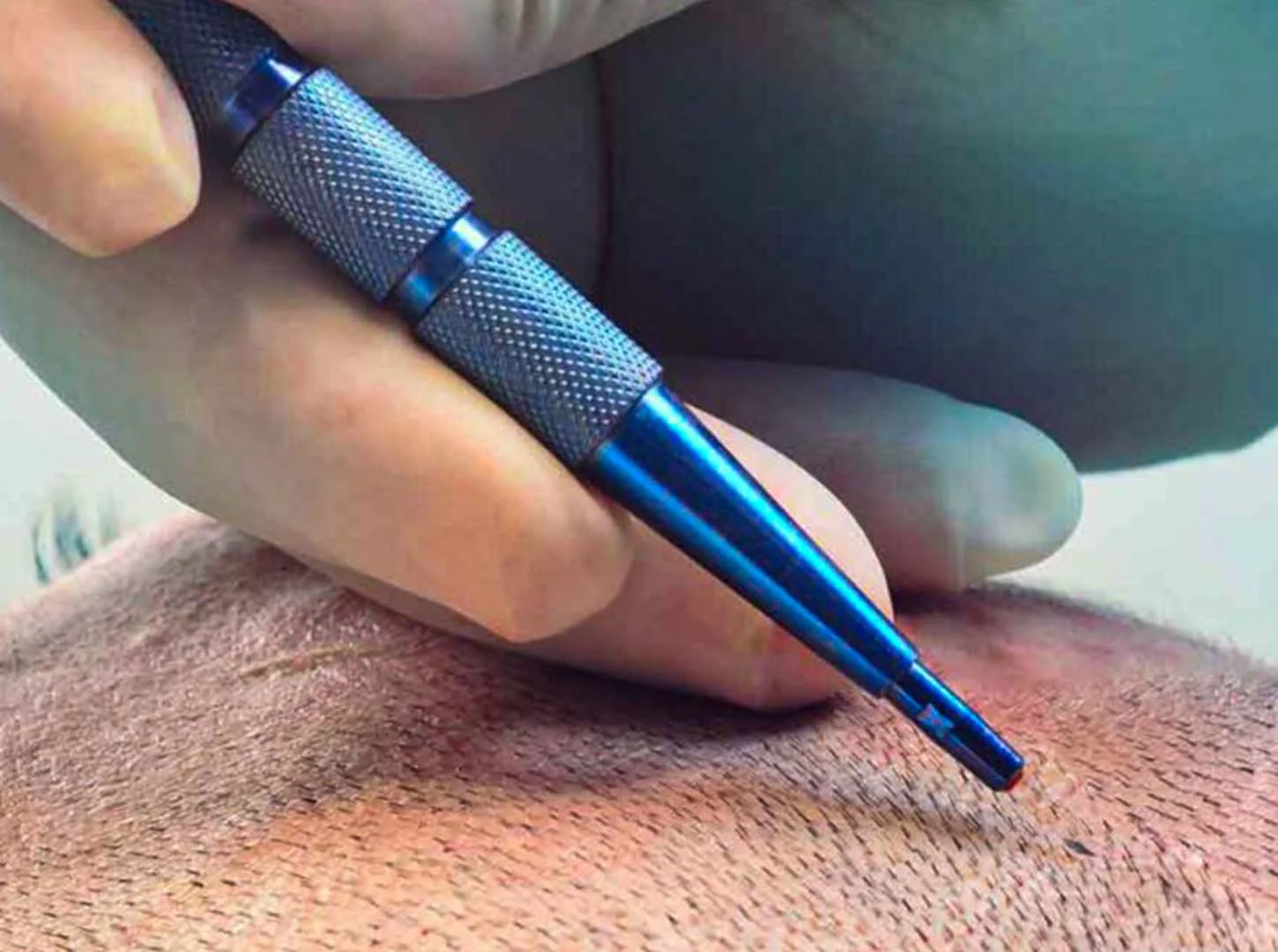
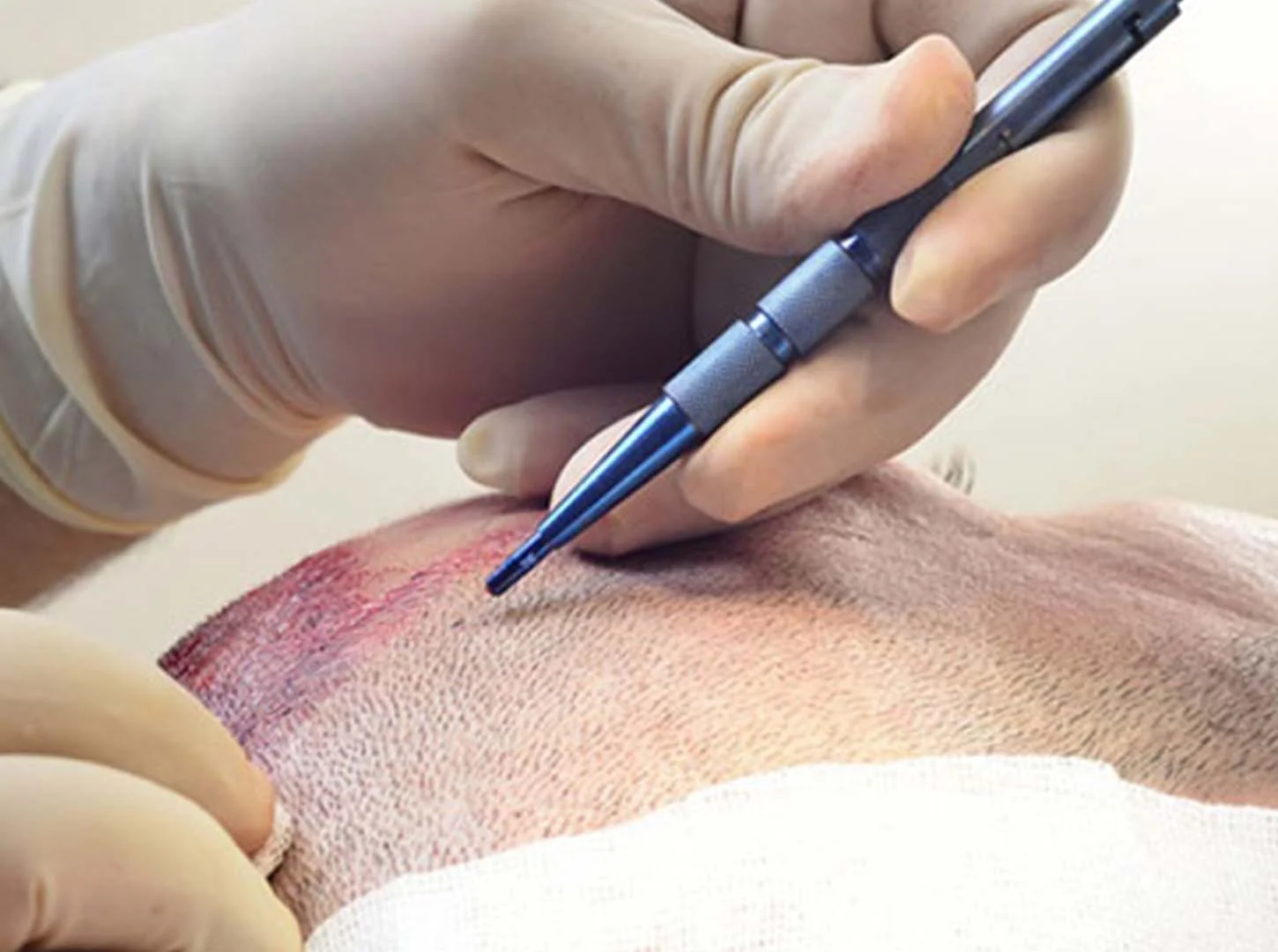
In Sapphire FUE, the extraction step is still performed with a small micromotor punch, usually around 0.7–0.9 mm. The difference comes during the second step, when the surgeon creates the recipient channels. Instead of using a traditional steel slit blade, the surgeon uses a V-shaped blade made from synthetic sapphire crystal.
Some patients hear the word “sapphire” and imagine the whole surgery is done with gemstone tools. It is not quite like that. The sapphire blade is a small surgical tip mounted on a handle. It is valued because the material is very hard, very smooth, and can hold a sharp cutting edge well.
For the patient, the point is not the material itself. The point is what that material allows the surgeon to do: open smaller, cleaner, more controlled channels that follow the natural angle of the hair.
If you are still comparing the main methods, our FUE hair transplantguide explains the foundation of the technique in more detail.
Sapphire vs Steel Blade: What Really Changes?
Steel blades have been used in hair transplant surgery for many years, and they still work well when used by an experienced surgeon. Sapphire is not about replacing a bad tool with a good one. It is about using a more refined tool for a very delicate part of the operation.
The biggest differences show up in channel size, sharpness, tissue trauma, and bleeding control.
Smaller Channel Size
A standard steel slit blade is usually wider than a sapphire blade. Sapphire blades can create narrower channels while still staying sharp during long sessions. Smaller channels mean less disruption to the surrounding skin, which can be helpful when we are trying to build a dense hairline.
Sharper Edge for Longer
Steel blades can dull during a large case. When that happens, the incision can become less clean. Surgeons may change blades during the session for that reason. Sapphire blades keep their edge very well, so the quality of the channels stays more consistent from the first graft to the last.
Less Friction
Sapphire has a smooth surface. In practice, that means the blade passes through the skin with less drag. Less drag usually means less irritation around the channel and a calmer recipient area after surgery.
Cleaner Field During Implantation
In many cases, sapphire channels bleed slightly less than traditional steel channels. This helps the team see the recipient area more clearly while placing grafts. That is especially useful around the hairline, where a few degrees of angle can change the entire look of the result.
So no, sapphire is not some flashy marketing gimmick when it is used properly. It is a technical upgrade in one specific step of the operation.
For a broader view of clinic selection and medical travel, you can also read our hair transplant Turkeyguide.
Sapphire FUE vs Standard FUE vs DHI
Patients often ask which technique is the best. The honest answer is that there is no single winner for every patient. Standard FUE, Sapphire FUE, and DHI each have a place.
| Feature | Standard FUE | Sapphire FUE | DHI |
|---|---|---|---|
| Extraction tool | Steel or titanium punch | Steel or titanium punch | Steel or titanium punch |
| Channel opening | Steel slit blade | Sapphire V-blade | Choi implanter pen |
| Typical density | 35–45 grafts/cm² | 45–55 grafts/cm² | 40–50 grafts/cm² |
| Best use | Crown and large coverage areas | Hairline, temples, dense frontal work | No-shave cases, women, smaller reinforcement work |
| Shaving | Usually full shave | Usually full shave | Partial or no-shave may be possible |
| Visible healing period | Usually 10–14 days | Usually 7–10 days | Usually 7–10 days |
| Typical session size | Up to around 4,500 grafts | Up to around 5,000 grafts | Usually up to around 3,500 grafts |
DHI is different because the Choi pen creates the channel and places the graft in one motion. That can be useful when working between existing hairs or when shaving needs to be limited. Sapphire FUE, on the other hand, gives us more flexibility in larger sessions while still allowing refined channel control.
For a detailed comparison, see our DHI hair transplantguide.
How the Sapphire FUE Procedure Works
A Sapphire FUE day is long, but it follows a very clear rhythm. Most patients are surprised by how calm the day feels once the anesthesia is done. You are awake, you can take breaks, and the team moves step by step.
Arrival and Final Planning
The day starts with final checks, photographs, and a review of the blood work. The hairline is designed while the patient is sitting upright. This matters because the forehead and scalp do not sit exactly the same way when someone is lying down.
The hairline design is not rushed. A good hairline should not only look good on surgery day. It should still look natural five, ten, and fifteen years later.
Donor Area Preparation
The donor area is shaved and cleaned. In most cases, the back and sides of the scalp are trimmed very short so the grafts can be extracted safely and evenly. Depending on the case, the recipient area may also be shaved for better visibility.
Local Anesthesia
Local anesthesia is the part most patients worry about. It is also the only part that tends to sting. Once the scalp is numb, the rest of the procedure is usually felt as pressure rather than pain. We use comfort techniques such as vibration and cooling to make this stage easier.
Graft Extraction
During extraction, follicular units are removed one by one from the donor area using a small punch. The grafts are then placed into a chilled holding solution until implantation. For larger cases, this stage can take several hours.
The quality of extraction matters just as much as the implantation technique. A beautiful channel is useless if the graft has been damaged before it reaches the recipient area.
Sapphire Channel Opening
This is the step that defines Sapphire FUE. The surgeon opens tiny channels in the recipient area using sapphire blades. Smaller blades are used for single-hair grafts at the front of the hairline, while slightly larger blades may be used behind the hairline for thicker grafts.
The angle and direction of each channel are planned carefully. In the frontal hairline, the channels are usually more shallow to mimic natural growth. In the crown, the direction changes to follow the swirl pattern.
Graft Implantation
Once the channels are ready, the grafts are placed into them. Single-hair grafts go at the front to create a soft, natural edge. Two- and three-hair grafts are placed behind them to create density.
This layering is one of the small details that separates a natural result from a harsh, artificial-looking hairline.
Final Check and Aftercare Instructions
At the end of the procedure, the donor area is bandaged lightly. The recipient area is usually left open. The team reviews sleeping position, medication, washing instructions, and the first few things to avoid.
A typical Sapphire FUE procedure can take around 8–10 hours including breaks, depending on graft count.
Why Sapphire FUE Can Create Denser Hairlines
Density is one of the main reasons patients ask for Sapphire FUE. But it is important to understand what density really means in hair transplant surgery.
A healthy scalp may have around 70–100 follicular units per square centimeter. A transplant cannot safely recreate that exact density in one session. The recipient skin needs blood supply, and if the channels are too close or too traumatic, graft survival can suffer.
In many patients, a safe transplanted density in the frontal zone is around 45–55 grafts per cm². Sapphire blades can help us work closer to that upper range because the channels are narrower and cleaner than traditional steel incisions.
The idea is not to pack grafts recklessly. More is not always better. The goal is to place enough grafts to create a strong cosmetic result while still protecting blood flow in the skin.
When the case is planned properly, Sapphire FUE can create a dense-looking hairline without making the front look heavy or unnatural.
Healing After Sapphire FUE
Patients usually care about one thing after surgery: when will it stop looking obvious? Sapphire FUE often helps here because the recipient channels are smaller and the surface trauma is lower.
Scabs and Crusts
With standard steel-blade FUE, visible scabs may take around 10–14 days to clear. With Sapphire FUE, many patients clear most visible scabs in about 7–10 days, as long as they follow the washing instructions carefully.
Redness
Redness depends on skin tone, sensitivity, graft density, and aftercare. Fair-skinned patients can stay pink longer, even after a technically perfect procedure. Still, in many Sapphire FUE cases, the recipient area calms down a little faster.
Shock Loss
Shock loss can happen after any hair transplant. It means some of the transplanted hair shafts, and sometimes nearby native hairs, temporarily shed after surgery. It looks worrying, but it is usually part of the normal cycle.
Sapphire channels may reduce trauma around native hairs, but they do not completely eliminate shock loss. Age, miniaturization, scalp health, and aftercare all play a role.
Sapphire FUE Cost in Istanbul
At Istanbul Care, Sapphire FUE starts from $1,990for an all-inclusive package. The final cost can change depending on graft count, case difficulty, and whether the plan includes a combined technique.
A typical Sapphire FUE package includes:
- Surgeon-performed sapphire channel opening
- Pre-operative consultation and blood panel
- Local anesthesia
- Hotel accommodation near the clinic
- Airport and clinic transfers
- PRP treatment after surgery
- Aftercare kit with shampoo, lotion, ointment, pain relief, and neck pillow
- Follow-up reviews during recovery
Larger 4,000–5,000 graft sessions usually cost more than small frontal cases. Some patients also benefit from a combined Sapphire FUE and DHI approach, especially when we want sapphire precision in the hairline and implanter-pen control in another area.
Compared with the UK, the US, and Germany, Istanbul is usually much more affordable. That price difference is not because the follicles are different or because the tools are cheap. It comes from lower local labor costs, lower clinic overhead, currency differences, and the high number of procedures performed in Turkey.
For a full breakdown of pricing and package logic, read our hair transplant Turkey costguide.
Who Should Choose Sapphire FUE?
Sapphire FUE is a strong option for many patients, but it is not the answer for everyone. A good consultation should look at donor density, hair loss pattern, age, future loss risk, and expectations before recommending a technique.
Good Candidates for Sapphire FUE
- Patients with Norwood 2–5 hair loss
- People who want a dense and natural-looking frontal hairline
- Patients with average to strong donor density
- Patients who need up to around 4,500–5,000 grafts in one session
- Men with stable or medically managed hair loss
- Patients who are comfortable with shaving for better surgical visibility
Less Ideal Candidates
- Advanced Norwood 6–7 patients who need staged coverage rather than dense frontal packing
- Patients with very weak or depleted donor areas
- Very curly or Afro-textured hair cases where extraction difficulty is the bigger issue
- Patients who cannot pause blood-thinning medication when medically required
- Patients with uncontrolled scalp conditions such as psoriasis, folliculitis, or seborrheic dermatitis
For curly or Afro-textured hair, the challenge is usually not the sapphire blade. The main challenge is the curved follicle under the skin. In those cases, experience with texture-specific extraction matters more. You can read more on our Afro hair transplantpage.
If you are not sure whether Sapphire FUE is right for you, you can send photos through our contact uspage and our team will review your donor area and hair loss pattern.
Sapphire FUE Recovery Week by Week
Recovery is not difficult for most patients, but it does require patience. The first ten days are about protecting the grafts. The first three months are about waiting. The real cosmetic change comes later.
Day 0: Surgery Day
The scalp may feel numb or tight. Swelling is usually not visible yet. Patients sleep with the head elevated and avoid touching the recipient area.
Day 1–3
Swelling can appear on the forehead and sometimes move toward the eyes. This is temporary. Cold compresses may be used on the forehead, but never directly on the grafts.
Day 4–7
Scabs become more visible. Itching may start. The washing routine matters a lot during this period. No scratching, rubbing, or picking.
Day 8–10
Most scabs begin to loosen and fall away. Some transplanted hairs may come off with them. This is expected. The follicle remains under the skin.
Week 2–4
The recipient area looks calmer, and the donor area is usually closed. Many office workers feel comfortable returning to normal social routines around this stage, depending on redness and hairstyle.
Week 4–12
This is the slow phase. Most transplanted hair shafts have shed, but new growth has not yet started properly. Patients sometimes feel like nothing is happening. That is normal.
Month 3–4
Early new hairs begin to appear. They are often thin, soft, and uneven at first. This is the beginning, not the final look.
Month 6
Roughly half of the final density is usually visible. The hair starts behaving more like normal hair and becomes easier to style.
Month 9–12
Density improves, the strands thicken, and the texture becomes more natural. For many patients, this is when the result finally starts to feel real.
Month 12–15
The result is assessed. Some patients, especially crown cases, continue to see small improvements after month 12.
Risks of Sapphire FUE
Sapphire FUE is safe when performed correctly, but it is still surgery. The technique has the same general risks as standard FUE, with a few points that deserve attention.
Channel Angle Problems
Sapphire blades are precise, but precision only helps if the surgeon controls the angle well. Poorly planned channels can lead to hair growing in the wrong direction or looking too upright.
Over-Densification
Because sapphire allows tighter placement, inexperienced clinics may try to overpack the area. That can reduce blood supply and hurt graft survival. Safe density is more important than impressive numbers on paper.
Blade Handling
Sapphire is hard, but it can be brittle. A damaged blade should never be used. Proper handling and blade checks are part of safe surgical practice.
Standard FUE Risks
Other possible risks include swelling, infection, folliculitis, temporary numbness, shock loss, and uneven growth. Most are mild or manageable when the clinic is experienced and the patient follows aftercare instructions.
Patient Case Example: David, 41, 4,200 Grafts
David came to Istanbul from Manchester with a receding hairline and a thinning crown. His hair loss pattern was around Norwood 4, and his donor density was strong enough for a single-session plan.
We planned 4,200 grafts with Sapphire FUE. Around 2,400 grafts were used for the hairline and frontal zone, while 1,800 grafts were placed in the crown.
The hairline was designed slightly conservatively because David was 41 and still had some risk of future recession. In the front, the goal was density without making the hairline look too low or too sharp. In the crown, the grafts were placed according to his natural swirl pattern.
The surgery took just under 10 hours including breaks. He returned home on day 4.
At month 3, most transplanted hairs had shed, and he was understandably nervous. That is one of the hardest stages psychologically because the mirror does not show progress yet. By month 6, the hairline was taking shape. By month 12, the frontal area looked dense and natural, while the crown showed a clear improvement.
David’s case is a good example of what Sapphire FUE can do in the right patient: not instant perfection, but a gradual, believable result that matures over the year.
Sapphire FUE FAQ
Is Sapphire FUE painful?
The local anesthesia injections are the uncomfortable part. After the scalp is numb, the procedure itself is usually painless. Most patients feel pressure rather than pain. Mild soreness during the first day or two is common and usually controlled with simple medication.
Can Sapphire FUE be done without shaving?
The donor area usually needs to be shaved. In smaller cases, the recipient area may sometimes be left unshaved, but for larger Sapphire FUE sessions, shaving gives the surgeon better visibility and usually produces a more controlled result.
How long do I need to stay in Istanbul?
Most patients stay around four nights. This allows time for arrival, consultation, surgery, first wash, medical check, and safe return travel.
Will the transplanted hair fall out?
Yes. The transplanted hair shafts usually shed between weeks 2 and 6. This is normal. The follicles stay in place, and new growth usually starts around month 3 or 4.
Can I combine Sapphire FUE with DHI?
Yes. Some patients benefit from a combined plan. Sapphire FUE can be used for the hairline, while DHI may be used for crown work or for placing grafts between existing hairs.
Is Sapphire FUE better than DHI?
Not always. Sapphire FUE is usually better for larger sessions and dense frontal work. DHI can be better for unshaven cases, women, and smaller reinforcement procedures. The right choice depends on the patient.
How many grafts will I need?
As a rough guide, Norwood 2 patients may need 1,500–2,500 grafts, Norwood 3 around 2,500–3,500, Norwood 4 around 3,500–4,500, and Norwood 5 around 4,500–5,500. More advanced cases usually need staged planning.
What is the success rate of Sapphire FUE?
In suitable patients, graft survival is usually high when the procedure is planned well and aftercare is followed. At Istanbul Care, month-12 survival averages are generally around 91–94%, depending on donor quality, healing, and post-operative care.
About the Author
Prof. Dr. Barış Kılıçis a hair restoration surgeon practicing in Istanbul. He has performed thousands of hair transplant procedures and uses Sapphire FUE as one of his main techniques for dense frontal reconstruction and natural hairline design.
Medically Reviewed By
Dr. Munire Salman, MD, dermatologist and hair restoration specialist at Istanbul Care. Reviewed for clinical accuracy in April 2026.
Disclaimer: Hair transplant results vary from patient to patient. Donor density, age, hair type, medical history, graft handling, and aftercare all affect the final result. This content is for informational purposes and does not replace a personal medical consultation.
Sapphire FUE Hair Transplant in Turkey
Turkey leads the world in Sapphire FUE hair transplants in 2025, with Istanbul clinics like Istanbul Care performing over 500,000 procedures annually at 70-80% less than Western prices—typically $2,200-$5,000 for 3,000-5,000 grafts, including luxury stays and transfers. This refined FUE variant uses sapphire blades for ultra-precise incisions, minimizing trauma and delivering denser, scarless results ideal for those searching "hair transplant in Turkey" and seeking natural restoration for genetic balding or thinning.
/media/ic/images/2026/01/Sapphire-FUE-Hair-Transplant-in-Turkey.webp)
What is Sapphire FUE hair transplant
Sapphire FUE elevates traditional Follicular Unit Extraction by incorporating sapphire-tipped tools for channel creation, enabling tighter graft spacing and seamless integration. Popular in Turkey's JCI-accredited centers, it handles up to 4,000 grafts in 6-8 hours, boasting 95% survival rates for lifelong growth.
How the sapphire blade works
Crafted from synthetic aluminum oxide (Al₂O₃), the sapphire blade's V-shaped tip—hundreds of times harder than steel—delivers razor-sharp, consistent cuts without dulling, creating micro-incisions (0.6-1.0mm) at precise depths and angles. This antimicrobial surface reduces bacterial adhesion, while its smoothness glides through tissue, slashing friction by 50% compared to metal alternatives.
Benefits of reduced trauma and faster healing
Smaller incisions limit tissue disruption, cutting swelling and bleeding by 60%, with scabs forming minimally and shedding in 3-5 days—half the time of standard FUE. Patients experience less post-op pain, enabling a swift return to routines, enhanced by Turkey's bundled PRP therapies that accelerate follicle anchoring.
Natural Looking Hairline Through Precise Techniques
The blade's adjustability allows 40-60° angulation matching native follicles, supporting 50-65 grafts/cm² for feathered density without "pluggy" effects. Turkish surgeons leverage 3D simulations for customized designs, yielding undetectable hairlines that evolve naturally with age.
/media/ic/images/2026/01/Steel-Blades-in-Classical-FUE-Grooving.webp)
Key Differences in Sapphire FUE Versus Classical FUE
While both extract individual follicles, Sapphire FUE's blade innovation refines the process for superior outcomes, making it the go-to in Turkey where clinics like Istanbul Care report 20% more patient opt-ins.
Steel Blades in Classical FUE Grooving
Classical FUE relies on steel chisels for slits, which bend under pressure, leading to wider (1-1.2mm) channels prone to irregular depths and higher trauma—resulting in more scabbing and 10-14 day healing.
Sapphire Tipped Pens for Reduced Errors
Sapphire pens maintain sharpness for error-free, uniform incisions, minimizing channel misalignment that could drop graft viability by 10-15%. This precision suits intricate temples, unlike steel's variability.
Faster Healing with Sapphire FUE Technique
Sapphire's glide reduces inflammation, healing in 5-7 days versus classical's 10-12, with 30% less redness—crucial for medical tourists resuming work quickly via Turkey's efficient packages.
/media/ic/images/2026/01/Faster-Healing-with-Sapphire-FUE-Technique.webp)
/media/ic/images/2026/01/Using-FUE-Engines-for-Graft-Extraction.webp)
Step by Step Sapphire FUE Hair Transplant Procedure
Outpatient in Istanbul's top facilities, the process under local anesthesia ensures comfort, with achieving 98% satisfaction through meticulous execution.
Using FUE Engines for Graft Extraction
Donor area (nape/sides) is numbed and trimmed partially; micromotor punches (0.7-1.0mm) harvest 1,000+ robust follicles/hour, preserved in chilled saline for 95% viability, extracting only 20-25% to sustain donor aesthetics.
Opening Channels with Sapphire Blades
Scalp is sterilized; sapphire blades craft V-shaped microchannels at exact angles/directions, spaced 0.5-1mm apart for dense packing—antiseptic properties further lowering infection odds to under 1%.
Planting Grafts for Natural Results
Sorted grafts (1-4 hairs/unit) are forceps-inserted into channels, mimicking growth patterns for seamless blending; LED therapy post-placement boosts oxygenation, common in all-inclusive Turkish protocols.
Ideal Candidates for Sapphire FUE Hair Transplant
Suited for stable hair loss patterns, Sapphire FUE thrives on Turkey's expertise, with free virtual consults assessing fit via trichoscopy for optimal planning.
Suitability for Genetic and Pattern Hair Loss
Those with androgenetic alopecia (Norwood 2-5 for men, Ludwig I-II for women) benefit most, as sapphire precision restores receding fronts or crowns without overharvesting—ideal for early intervention.
Requirements for Sufficient Donor Area Grafts
Candidates need 40+ follicles/cm² in the donor zone, healthy scalp (no psoriasis), and realistic goals; BMI under 30 and non-smoker status enhance outcomes, evaluated pre-op.
Options for Both Male and Female Pattern Baldness
Men gain angular, robust lines; women receive diffuse coverage preserving length via partial unshaven methods—30% of Turkish patients are female, per 2025 Clinics data.
/media/ic/images/2026/01/Suitability-for-Genetic-and-Pattern-Hair-Loss.webp)
Enjoy Benefits of Sapphire FUE Hair Transplant
Beyond affordability, Sapphire FUE's innovations deliver transformative confidence, with Turkey's surgeons pioneering it since 2016 for unmatched naturalism.
Achieve Natural Looking Results with Dense Hair Growth
Supports 50-60 grafts/cm² for lush volume, with directional implantation ensuring curls/waves align—patients note 85% density by month 6, evolving to full permanence.
Experience Minimal Scarring and Less Discomfort
Dot-like scars (0.1mm) fade invisibly in weeks, with numbing limiting pain to a pinch; no stitches mean 70% report zero downtime discomfort.
Recover Faster Thanks to Reduced Tissue Damage
Less edema allows desk work in 2-3 days; sapphire's minimal invasion cuts recovery by 40%, bundled with soothing kits for seamless healing.
/media/ic/images/2026/01/See-Full-Natural-Hair-Growth-by-Twelve-Months.webp)
Follow Recovery Timeline After Sapphire FUE Hair Transplant
Turkey's post-op support—apps, meds—guides a smooth journey, with 95% complication-free rates ensuring worry-free results.
Manage Swelling and Scabs in First Few Days
Days 1-3: Ice forehead swelling (peaks day 2), gentle saline rinses shed scabs by day 5; avoid sun/rubbing, using Clinics-provided foams.
Expect Temporary Shedding After One to Two Months
Week 2-8: Telogen effluvium sheds transplants (normal in 20%), but roots anchor; minoxidil resumes at week 4 for support.
See Full Natural Hair Growth by Twelve Months
Month 3: 20-30% sprouts; month 6: 60-70% density; year 1: Complete, mature growth—tele-follow-ups track progress for refinements.
Learn Sapphire Pen Technique for Better Results
The Sapphire Pen Technique refines FUE by employing sapphire-tipped implanters or blades for incision and placement, enabling surgeons to achieve unparalleled density and naturalism. In Turkey's advanced facilities, this method supports up to 60 grafts/cm², surpassing traditional tools for patients desiring seamless, high-volume restoration.
Open Smaller Micro Channels to Minimize Tissue Damage
Sapphire pens create V-shaped micro-channels as small as 0.6mm—40% narrower than steel equivalents—reducing tissue dissection and inflammation by 50%. This precision preserves scalp elasticity, allowing denser packing without over-stretching, and accelerates healing to 5-7 days, as evidenced by clinics like Istanbul Care.
Place Grafts at Desired Angles for Natural Growth
With adjustable sapphire tips, grafts are implanted at 30-45° angles mirroring native follicles, ensuring directional growth that blends undetectably. This control minimizes "upright" failures, yielding 20% more natural feathering for hairlines and crowns, ideal for curly or fine hair types.
Avoid Allergy Risks Unlike Steel Slits
Sapphire's hypoallergenic, non-metallic composition (aluminum oxide) eliminates nickel-related reactions common in 5-10% of steel users, reducing post-op irritation by 60%. Its antibacterial surface further lowers infection odds to under 1%, enhancing safety for sensitive scalps.
| Feature | Sapphire Pen Technique | Steel Blades |
|---|---|---|
| Channel Size | 0.6-1.0mm (V-shaped) | 1.0-1.2mm (U-shaped) |
| Tissue Damage | 50% less inflammation | Higher friction and trauma |
| Angle Precision | 30-60° adjustable | Limited to 20-40° |
| Allergy Risk | Hypoallergenic, 0% metal reaction | 5-10% nickel sensitivity |
| Healing Time | 5-7 days | 10-14 days |
Planning your Sapphire FUE hair transplant journey
Embarking on Sapphire FUE in Turkey involves strategic preparation, leveraging virtual consults from clinics for personalized roadmaps. With over 90% satisfaction rates, this journey promises transformative, lifelong results at a fraction of global costs.
Cost considerations and value for money
At $2,200-$5,000, Sapphire FUE delivers exceptional ROI—up to 80% cheaper than the US's $20,000 average—covering grafts, anesthesia, and luxuries like 4-star hotels. Value shines in 95% permanence and minimal revisions, outpacing pricier alternatives for moderate-to-advanced loss.
How to prepare and what to consider before surgery
One week prior, cease blood thinners (e.g., aspirin), alcohol, and smoking to optimize blood flow; maintain a protein-rich diet and avoid hair dyes. Consider donor density via trichoscopy during free online assessments—ideal for Norwood 2-5 stages—and select JCI-accredited clinics for safety.
Aftercare, growth timeline and long term results
Post-op kits include medicated shampoos; sleep elevated for 3 days to curb swelling. Timeline: Days 1-7 scabs shed; month 1 shock loss; months 3-6 30-60% growth; year 1 full density. Long-term: DHT-resistant follicles ensure 85-95% retention for decades, with annual check-ins.
/media/ic/images/2026/01/Aftercare-growth-timeline-and-long-term-results.webp)
Cost and planning your Sapphire FUE treatment
Turkey's all-inclusive model streamlines budgeting, with packages from Istanbul Care at €1,500 for 1,500 grafts, emphasizing transparency and inclusions for hassle-free medical tourism.
Cost range and package details
Entry-level: $2,200 for 2,000 grafts; premium: $4,500-$5,000 for 4,000+ with VIP transfers and PRP. Packages bundle 3-5 nights' accommodation, meals, and lifetime warranties, as at our Clinics.
Factors affecting overall price
Graft count (1,500-5,000), surgeon expertise, and add-ons like beard restoration inflate costs by 20-30%; Istanbul locales add 10% for convenience, but volume discounts apply for mega-sessions.
Aftercare and long-term hair growth
Gentle saline rinses from day 2; avoid sun/gym for 10 days. Growth: Visible sprouts by month 3, 80% density by 6; mature by 12-18 months. Sustained via minoxidil if needed, with 90% patients reporting unchanged results at 5 years.
/media/ic/images/2026/01/Enjoy-Benefits-of-Sapphire-FUE-Hair-Transplant.webp)
Common side effects after Sapphire FUE hair transplant
Sapphire FUE's finesse yields milder effects than standard FUE, with 98% resolving sans intervention in Turkey's monitored settings—focus on hydration and compliance for swift passage.
Temporary swelling around donor and recipient areas
Forehead/eye puffiness peaks days 2-4 (affecting 40%), eased by ice and elevation; sapphire's minimal trauma halves duration versus steel, fading by day 5 without meds in most cases.
Mild itching and redness as scalp heals
Itch from healing channels emerges days 3-7, managed with Clinics lotions; redness mimics a mild sunburn, subsiding in 5-10 days—antihistamines curb it, rare in hypoallergenic sapphire use.
Shock loss of surrounding hairs before regrowth
10-20% native hairs shed weeks 2-8 due to trauma, regrowing stronger by month 3; transplanted follicles anchor immediately, unaffected—PRP in packages boosts recovery by 15%.
Frequently Asked Questions
Our Location

Reach Us Now
Speak with our expert DHI Hair Transplant specialist We're ready to answer your questions